
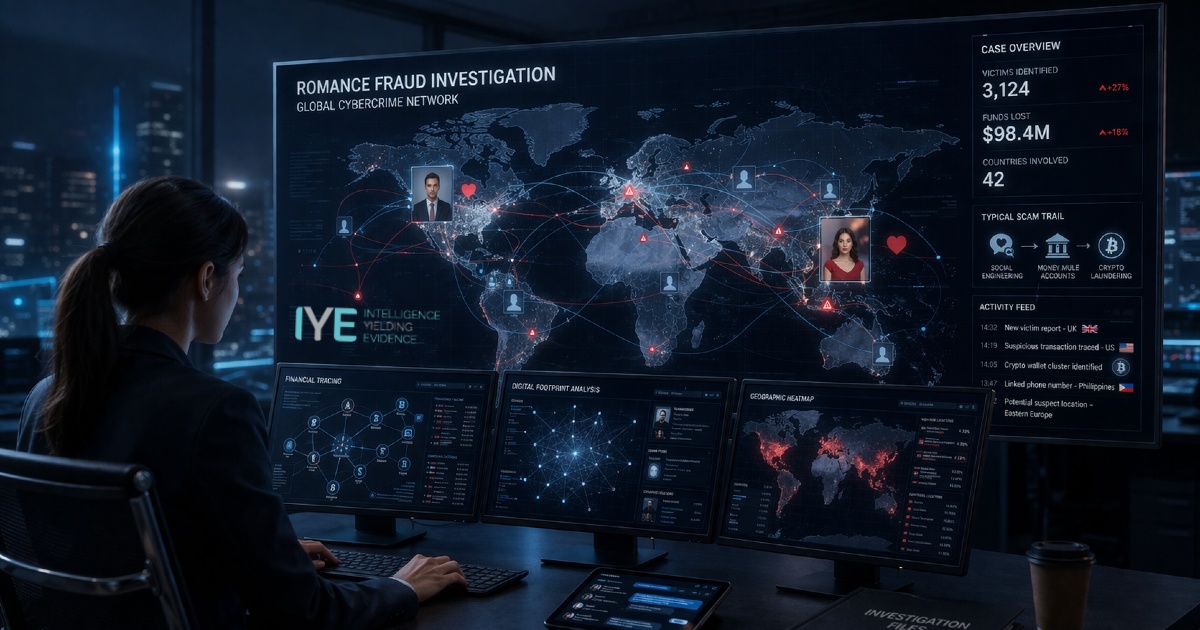
Romance fraud has rapidly evolved into one of the most pervasive and psychologically manipulative forms of cyber-enabled financial crime. While the public narrative often focuses on emotional deception, the reality behind these cases reveals a far more complex and structured criminal ecosystem—one that requires specialist investigative capabilities to dismantle.
Behind every fraudulent relationship lies a carefully constructed digital persona, supported by networks of bad actors operating across multiple jurisdictions. These are not opportunistic scams; they are coordinated operations designed to exploit trust, engineer emotional dependency, and ultimately facilitate financial extraction.
A Multi-Layered Criminal Framework
Investigating romance fraud is rarely straightforward. Cases frequently involve:
- Fabricated identities supported by stolen or synthetic imagery
- Compromised or mule bank accounts spanning several countries
- Encrypted communications across multiple platforms
- Cryptocurrency transactions designed to obscure financial trails
Fraudsters deploy social engineering techniques with precision, often maintaining prolonged contact with victims to build credibility. By the time financial requests are introduced, the victim is typically deeply invested—emotionally and psychologically—making detection and intervention significantly more challenging.
The Digital Forensics Challenge
At the core of any successful investigation is the ability to reconstruct a fragmented digital footprint. This involves correlating data points from:
- Messaging platforms and email headers
- IP logs and device fingerprints
- Financial transaction pathways
- Open-source intelligence (OSINT) and dark web indicators
However, modern romance fraud cases increasingly leverage anonymisation tools, VPNs, and decentralised financial systems. This raises the evidential threshold and demands advanced analytical tools capable of identifying patterns that are not immediately visible.
Leveraging Advanced Technology
To address these complexities, leading investigation firms now integrate artificial intelligence into their workflows. Proprietary platforms such as COBRA AI are designed to:
- Aggregate and analyse large volumes of structured and unstructured data
- Identify behavioural patterns consistent with known fraud typologies
- Map networks of associated accounts and digital identities
- Accelerate attribution and evidential development
This technological layer significantly enhances investigative efficiency, allowing specialists to move beyond reactive casework towards proactive intelligence gathering.
Following the Money
Financial tracing remains a critical component in romance fraud investigations. While traditional banking channels still feature prominently, there has been a marked increase in the use of cryptocurrency and layered transactions to obfuscate fund movement.
Effective asset tracing requires:
- Cross-border financial intelligence
- Blockchain analysis capabilities
- Collaboration with financial institutions and regulatory bodies
Even in cases where funds have been rapidly dispersed, identifying aggregation points or exchange touchpoints can provide viable recovery opportunities.
The Human Element
Despite the technical sophistication involved, romance fraud investigations are ultimately centred on people. Victims often face not only financial loss but significant emotional distress, reputational concerns, and, in some cases, reluctance to report due to stigma.
A structured investigative approach must therefore balance:
- Sensitivity and discretion
- Clear evidential reporting
- Practical recovery strategies
Building trust with victims is essential, particularly when reconstructing timelines and extracting key information that may initially appear insignificant but proves critical in the broader intelligence picture.
A Global Response to a Global Problem
Romance fraud is inherently transnational. Criminal networks exploit jurisdictional gaps, making enforcement and recovery more complex. As a result, effective investigations require:
- International cooperation
- Multi-jurisdictional legal awareness
- Access to global intelligence networks
- Relations with law enforcement agencies
Organisations specialising in fraud recovery and cyber investigations are increasingly positioned at the intersection of private intelligence and law enforcement support, bridging critical gaps in capability and response time.
Conclusion
Romance fraud is far more than an online deception—it is a structured, data-driven crime that blends psychological manipulation with financial engineering. Investigating these cases demands a combination of digital forensics expertise, financial intelligence, and advanced technology.
As criminal methodologies continue to evolve, so too must the investigative frameworks designed to counter them. The ability to untangle these complex webs of deception is no longer optional—it is essential in protecting victims and disrupting the networks that exploit them.
Have You Been Affected by Romance Fraud?
If you or someone you know has been impacted by romance fraud, it is important to act quickly—but also carefully. These cases are often far more complex than they first appear, involving multiple jurisdictions, layered financial transactions, and sophisticated deception techniques.
At IYE Global, we approach every case with discretion, sensitivity, and a clear investigative strategy. Our team of specialists will assess your situation confidentially, helping you understand what has happened, identify potential recovery options, and determine the most effective next steps.
All enquiries are handled in strict confidence. If you would like to discuss your circumstances or explore potential solutions, we invite you to speak with our team.
About the author

IYE Global contributor covering fraud intelligence, investigations, compliance and sector developments.